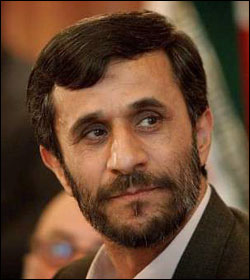
Here is just some background information on Ahmedinejad taken from the Iranian Chamber Society. What do you think about his extensive education considering what you know about his Presidential platform?
 |
Mahmoud Ahmadinejad
Following the 1979 Islamic revolution he became a member the conservative faction of the Office for Strengthening Unity [OSU] Between Universities and Theological Seminaries. The OSU was established by Ayatollah Mohammad Beheshti, one of Ayatollah Khomeini's key advisors, to organize Islamic students against the rapidly growing Islamic group of Mojahedin-e Khalq (MEK). With invasion of Iraq and start of the Iran-Iraq war in 1980, Ahmadinejad rushed to the western fronts to fight against the enemy and joined the voluntary (basij) forces of the Islamic Revolution's Guards Corps (IRGC). He served in different units of the Islamic Revolution Guards Engineering Corps. He served as governor of Maku and Khoy cities in the northwestern West Azerbaijan province, and as an advisor to the governor general of the western province of Kurdistan for two years. While serving as the cultural advisor to then Ministry of Culture and Higher Education in 1993, he was appointed as governor general of the newly established northwestern province of Ardebil from 1993 to 1997. He was elected as the exemplary governor general for three consecutive years. But in 1997 the newly-installed Khatami administration removed Ahmadinejad from his post as Ardebil governor general. He returned to the University of Science and Technology (Elm-o-Sanaat) again to teach in 1997. In April 2003 Ahmadinejad was appointed mayor of Tehran by the capital's municipal council, which is dominated by the hard-line Islamic Iran Developers Coalition (Etelaf-e Abadgaran-e Iran-e Islami). In some of Ahmadinejad's public statements, he has appeared to identify himself as a Developer. He lives a very Spartan lifestyle and that's how he projected himself. As Mayor, he reversed many of the policies of previous moderate and reformist mayors, placing serious religious emphasis on the activities of the cultural centers by turning them into prayer halls during the Islamic holy month of Ramadan. He also suggested the burial of the bodies of martyrs of the Iran-Iraq war in major city squares of Tehran. On 24 June 2005 Dr. Mahmoud Ahmadinejad was elected as Iran's sixth president. He swept to the presidential post with a stunning 17,046,441 votes out of a total of 27,536,069 votes cast in the runoff election. http://www.iranchamber.com/history/mahmadinejad/mahmoud_ahmadinejad.php |

36 comments:
This biography gives important keys to understand some of Ahmadinejad's actions as a President.
His experience in the basij forces during the Iran-Iraq, when America was involved with Iraq, could explain his anger toward America and therfore his very provocative speeches against the U.S.. For instance, his campaign film emphazises this aspect. Indeed, during most of it, he is talking to veterans from Iraq-Iran war or praying.
Additionally, his formation as a doctor in civil engineering is quite impressive and sharply constrasts with the public representation of Ahmadinejad as a "common and modest man", his "spartan lifestyle" and his populist platform for presidency.
I think it is interesting how the American public and media portrays Ahmadinejad as a totalitarian extremest, when he is actually an educated man. Although his moral opinions do not 'mesh' with ours, his PhD in civil engineering must make him somewhat qualified to contribute to the structure of the country of Iran.
I also found the platform that he ran on as mayor of Tehran interesting. Tehran's dense population must have called for a stern and progressive leader, and thr fact that Ahmadinejad was so involved in building cultural centers, and living a humble life showed his determination.
Although controversial, it is interesting to be educated about how Ahmadinejad came to be in power.
Ahmadinejad's extensive involvement with the IGRC and Basij in his youth can serve to explain why Ahmadenijad was such a fierce critic of US imperialism during his 2005 bid for the presidency. The carnage he must have witnessed in the front line during the Iran-Iraq war can also shed light on why Ahmadinejad was adamantly opposed to normalizing US relations with the west and opposed to the veto power of members of the UN security council.
Ahmadinejad's education as an engineer helps to explain his concern with the economic development of the country, but makes his failure to do so paradoxical.
Ahmadinejad's humble upbringing may also explain why he made so many appeals to poor and low income families during the campaign, namely, his promise to more equitably distribute the oil profits of Iran.
It is also interesting to note that Ahmadinejad's biography does not match neatly with the image of him popularized in the Western press as a radical and militant Anti-Semite.
I agree with the previous posters that his education level shows that he is not the "ignorant idiot" that the media portrays him as. Spending that much time in a university and even teaching students probably made him more aware than other people. However, you still have to remember that his field is engineering. While the overall outcome of an engineering project provides amazing products for citizens in the area of infrastructure. While he is very educated, it is not as if he had a doctorate in political science or sociology. The information he knows about how to run a government was learned through his experience in the various facets of Iranian government. Also, as stated by previous bloggers, his experience in the army during the Iran-Iraq War definitely had a huge effect on his current political stances.
This biography that was provided for Ahmadinejad helped me developed a different perspective of the man that I have been seeing portrayed by American media. Having an understanding for his background provides an individual with a deeper perspective on the decisions and actions he makes as Iran's president today. After reading about the time he spent involved in the Iran Iraq war it would only make sense for a human to have hatred or at least resentment towards the United States after Backing the Iraqi military in the Iran Iraq war. Ahmadinejad witnessed the bombing of his home town and a million of his people die due to this War. However, he must have supported the war due to his pro-Islam and anti-Shah stance. If anything, I would imagine he is a little jaded towards the U.S. given the political history we have with that country.
There are a lot of things that the mass media does not portray about Ahmadinejad which would serve to possibly paint another image of him in the Western world or at least help to clarify some questions. I, for example, was not aware that he was so extensively educated. His humble demeanor, some of the things he has said in regards to international relations, and decisions he has made in relation to Iran's oil distribution forces one to doubt his scope of knowledge. With this information, it makes it harder to believe that this man does not know what he is doing when he makes decisions.
His view on integrating Western ways in Iran reflect on his upbringing and involvement in the Iran/Iraq war. For someone who witnessed firsthand the brutal and detrimental outcome of the US back Iraq attack on Iran and its civilians, animosity and refusal to collaborate with the west is not abnormal.
After reading Ahmandinejads biography its seems that he is a patriotic man. Maybe he believes in the philosophy of Machiavelli, "It is better to be feared than loved." My heart goes out to the Iranian people who have suffered from this regime. But the Basij are my Iranian brothers also. Most likely they are brainwashed by the Mullahs.
I do not want to see another Iranian die in this conflict, but unfortunately I know that if we continue in this path many more will suffer. That is why I ask my brothers and sisters to reduce our casualties by not confronting the Guards or the Basiji head on in these insignificant street battles. We do not possess or have the means of acquiring the weapons and training to turn these street battles into a form of guerrilla warfare were we can be victorious.
The most effective way to strike a blow to the mullahs is to hurt the economy.It is our money that goes towards their paychecks, guns, batons, motorcycles, armor and bullets.
So after reading about this biography, I almost want to ask if we are discussing the same person. It is interesting that the American media shows Ahmadinejad as this ignorant man who refutes well-known history, when this biography illustrates this picture of a man who is well-educated and just so happens to be the President of his country.
The biography seems to stay clear of religion, and that is a part of his life I want to know more information about. The biography touches on his military background, but doesn't go into explaining how those experiences formed who his current political stances. The biography touches on the organizations that he joined as a result of his religious views after the revolution, and talks about his rise to power. But really, his political rise to power is not a special story, or perhaps I just don't care about how he got involved in politics.
I want to know what happened in his life in order for him to have the beliefs that he has towards, Israel, government, women, international relations, the "West", and towards his own religion. What was his childhood like? How did his parents raise him? Were they the ones that instilled these mentalities within him? What was it like to be an engineer in the military? What did he see and how has that shaped how he views warfare? How does his current wife feel about his political and economical views?
And lastly, how can someone so educated be so ignorant?
Ahmadinejad is a very interesting person indeed. I think that is the point that many Americans are not aware of. At least not yet. He is highly educated and projects a humble existence, at the same time makes some profound statements which are very inappropriate, to say the least. This leaves me with the question: What is going on behind closed doors in Iranian politics?
I think the biography would be an interesting read.
On a different point. Did we just watch a Fox News report at UC Berkeley? Did Fox News really mention that Ahmadinejad is the second guy in charge and it is the supreme leader who calls the shots when all is said and done? This shows that even a broken clock is right twice a day.
Most importantly, this shows that the media is getting better at pointing out the differences in the Middle East.
This biography pushes a point that continually seems to be missed among many people in institutes of higher education, especially Berkeley: "well-educated" is not necessarily synonymous with liberal. While it's true that there's a historic trend of increasingly liberal views with increasing education, even in this country, the closer you go to the Midwest or into the Southeast, students are more likely to be conservative. Therefore I, too, would like to hear more about how his views developed, and where he learned them--was it instilled in him from an early age, or learned later in life? And it's perplexing--or maybe just typical--that there are so such vastly different portrayals of him, depending on which source they are coming from.
Although this article provides plenty of interesting information (information that American News commentators ought to be made aware of), it leaves me with lots of questions about how Ahmadinejad got into politcs in the first place. How did he get from being a civil engineer to being governor? How did he move up to being the cultural advisor? He transistioned back into a teaching position for a while, what promted him to back off from politics? This article really leaves out quite a bit of context for the narrative of Ahmedinejad's life.
Ahmadinejad clearly got some connections to political power and I want to know how he made these connections. I am also curious what his identification as a "devloper" means. What was he trying to devlop in Tehran and how did he go about it? How did the son of an ironworker climb to this position of international visibility? Clearly, Ahmadinejad has a powerful intellect and was rewarded by the Iranian educational syestem for it. However, this does not explain his transition into politics. What encouraged the municipal counsel to select this man as mayor?
I found it very interesting how the American media portrays Ahmadinejad as being a despotic/authoritarian ruler when he evidently has political experience and is educated in civil engineering. This experience contributes to his reforms in infrastructure in Iran society, which is key to a thriving youth. His reforms in infrastructure explains his concern with economic development in terms of transportation and health reforms. He obviously knows what he's talking about in that he called out the U.S. on its exploitative imperialist aims in Iran. He definitely isn't as ignorant as America makes him out to be.
It’s quite ironic that he has a PhD in “the field of engineering and traffic transportation planning” and as Tehran mayor he completely failed to address one of the major problems of Tehran which is traffic. Ghalibaf, his successor, has done more as mayor than Ahmadinejad ever did. As a mayor he was more concerned about separation of men and women in buses and elevators.
I think this biography makes him look good. He has done nothing to help the poor but with his failed economy plans has made life much harder for them. Right now the cost of housing is so high that many people can not afford to own a house and inflation rate is quite high. Before this year’s election, he distributed free rice, oil, and corn in different villages in Iran and also raised the retirement pension. All of these “good deeds” immediately stopped after he was elected president and he lowered the retirement pension. In 2006, 50 of Iranian economist wrote him a letter criticizing him for his economy plans and actions.
As for education and what is known as “second cultural revolution” he made many Iranian professors who were experts in their fields to resign and replaced them with those who are more inline with his mentalities. He set forth policies that would lower presence of women in universities.
one’s body of work and not the level of education, is a reflection of one’s personality. His religious beliefs give a better idea of the man he is. He is a follower of Ayatollah Messbah Yazdi who encouraged and issued religious orders (fatwas) for the 1998 Chain Murders of Tehran and is one of the most radical Ayatollahs who wants to become the next Supreme leader and In my opinion, one of the most dangerous politicians in Iran.
Ahmadinejad's early years and education were in fact quite impressive, but did not seem to forshadow his future after the 1979 revolution.
Before the revolution, Ahmedinejad went to school at the University of Science and Technology studying civil engineering. We was a member of the scientific board of the Civil Engineering College at his university, and eventually got his PhD doing research in traffic and transportation planning.
After 1979 Ahmadinejad became a conservative politician (and at one time, a soldier in the iran-iraq war), who wanted to strengthen the ties between church and state in Iran. His most honorable position is obviously his post as Iranian President; however, prior to this he was also mayor of Tehran and held various governor positions.
Besides a brief stint of teaching at his alma mater in 1997, his later life had little to do with his focuses and the education of his early years.
Considering what we know about Ahmedinejad's political agenda, I found the most interesting aspect of this biography was the impressive academic resume he has compiled. A 'humble' upbringing in Tehran brought him to the University of Science and Technology where he fared very well. He would then return as a member of the scientific board of the Civil Engineering College only to receive his PhD in the field of engineering and traffic transportation planning a year later. As impressive as this resume might be, the interesting aspect this biography provides is by trying to link his academic background to his actions as Iran's 6th President. Perhaps it was his humble upbringing that pushed him to act as a voice of the impoverished- a far cry from the evil tyrant western media portrays him as. However, I still can't help but wonder how humble his upbringing really was. Although this biography seems to disprove our western image of Ahmadinejad, all is not forgiven. It is hard to ignore the mass amounts of criticism he has received.
Obviously Ahmadinejad is no fool. The media in America attempts to portray him as an extremist and crazy when they bash in quotes from Ahmadinejad such as "wanting to blow Israel off the map". But it's obvious Ahmadinejad is "crazy like a fox" - he knows exactly what he is doing when he does it.
I did find it interesting to find that he received a PhD in Civil Engineering and traffic transportation planning, since, considering sharmin's comment, he has failed to address these types of issues within Iran. I would agree in saying that this article makes him look a bit too good, without addressing some of the major conflicts that have come up in his political career.
Before this class and reading this article, I was unaware that Ahmadinejad was so extensively educated. In the media, he is never referred to as “Dr. Ahmadinejad.” I believe this is an intentional misrepresentation by the media in order to easily delude the public that Ahmadinejad is simply an irrational, ignorant man whose opinions do not count. Another interesting piece of information I learned was about his humble upbringing, especially in contrast to Rafsanjani. I know in Iran he is perceived to be a populist, man-of-the-people type person and his humble upbringing is stressed as part of the propaganda.
It is also fascinating that Ahmadinejad used to be an educator. He seems very apt at teaching Iranians very specific messages, almost as if he is molding them into his ideal students.
The article provides a huge insight into Ahmadinejad's life, but also leaves many questions. As someone mentioned before it made me even more curious as to his religious stance. Also it amazes me how the west, which prides itself on being so educated completely decimated this man even though he is clearly as "educated" as many of the men running our government. Though the distinction must be made in having the ability to be a critical social thinker and being "educated". Bush was educated.
His experience from the war copulated with Irans history explains his angry view on the US. It surprises me however how he was so involved in the university and yet the student voice seems to be neglected still. Also it poses questions to his humble leaving platform, for while I understood his childhood may have been humble, he clearly rose quickly to upper middle class, from the positions he held and his high education. It questions certainly why he ran on the platform he did and explains why he is progressive but not revolutionary.
I was glad to have the 'basic' facts on his upbringing. What particularly interested me was his education, specifically his higher education. He received a doctorate, which is no easy feat. Even in the USA this is no easy 33% of Americans even go on to undergraduate education. He is obviously an extremely intelligent person, although this is not emphasized in the media. However, what really got me wondering is what caused the sudden jump. He went from being a scholar focusing on engineering and traffic transportation planning and a teacher to a governor, then mayor, the president? It seems like quite a leap to make. It make me wonder what caused him to switch his focus. I would like to see somebody ask him about this or perhaps read up about it to see if there is an explanation. Perhaps the explanation is in the military experience and how the changed him and introduced him into the political system, but I guess I'm just thinking about how strange it would be to see somebody I know who is going the engineering route make it all the way and earn a doctorate to simply completely change tracks and then run for mayor.
I think his education makes his policies even more surprising. What I find curious is that he took his college entrance exams in 1975 but the Revolution wasn't until 1979. So I'm assuming he got his undergraduate education under the Shah's regime. If that is the case, I can't help but wonder why he is so conservative, or seemingly conservative on some issues. For example, banning Western music for being too obscene. I suppose its likely that it is precisely the experience with the Shah's Western modeled society that pushed him in the opposite direction to embrace Islamic revolutionary ideals, but it is a curious thing. It rather seems to me like an MIT student going on to passionately champion a fundamentalist Christian government here in the USA. Inconceivable before the fact.
It is very interesting to see how Mahmoud Ahmadinejad is portrayed in two different aspects. In the United States, Ahmadinejad is viewed as an extremist individual who serves as the figure head for a nation that defies the west. However, the fact that he is actually an educated man is notable here because that shows that there is some credential that he is acting with when he rules his nation. Moreover, the fact that Ahmadinejad fights for other countries in the Arab world is also important because it shows that he is at least somewhat more dedicated than other countries in the region.
Moreover, the fact that Ahmadinejad grew up in an Iran that was faced up against the west, an Iran after the 1979 Revolution and an Iran that faced a western backed Iraq in a gruesome war that tarnished Iranian hope and faith in Western society is only more reason for his actions against the West currently as President.
After seeing his campaign video in class and reading his biography, I can better understand why Ahmadinejad is (or was) such a popular candidate. Just as our country has a divide between progressive urbanites and conservative rural folk, so does Iran. Ahmadinejad ran on a platform that emphasized his humble beginnings and to his advantage he won support from those who still live a traditional lifestyle in Iran.
As far as his education goes, I'm actually not that surprised he earned his PhD. I see people on the blog complain that the American media does not ever mention his education, but honestly how often does the media mention the credentials of world leaders when most are highly educated anyway?
I think his patriotism, conservatism, and humbleness is what got him elected in the first place, not his education attainment.
In being a highly educated man, I also would not consider him ignorant, even when he makes such ridiculous claims. I figure he makes those claims because he's a shrewd politician and wants to advance his ideology no matter the price.
Many people that have commented on this article seem to be surprised that Ahmadinjad has so much formal education. I had known from before that his formal education was in civil engineering but even I didn't know of the extent of his education. Nevertheless, let's keep in mind that although he may be an adroit engineer, his formal education does not translate into ability as a politician. After all, his job isn't to gauge the structural integrity of the high rises in Iran, but to represent millions of people. In short, I believe he has few formal qualifications to be the mayor of Tehran, let alone the President of Iran. This becomes quickly evident when one considers the likes of Rafsanjani, who was clearly very familiar with the economy of Iran and how to best create wealth for the country.
Lastly, I'd like to go off on a tangent and point out the reason why many people viewed Ahmadinejad as very uneducated. When the media constantly batters the image of a "stupid" leader into the heads of Americans, it leads the public to believe that Ahmadinejad has had no education whatsoever. This is clearly not the case as proven by this article. Indeed, I believe Ahadminejad's situation is analogous to Bush's. The media portrayed Bush as child-like and idiotic. Regardless of your views of Bush's decisions in office, you have to admit that Bush cannot be as dumb as the media portrays him to be. After all, he ran a country for 8 years.
Interesting biography. It's interesting to see how educated he is. Also, he seems to have come from a very humble background. It's hard to look at the biography and project that he could be president based on that seemingly normalcy - no lavishness was mentioned at all.
Now to play devil's advocate: just because he's educated doesn't mean he's a logical and rational president. Religion and biases often overpower intelligence. And since high-level politics don't seem to be part of his background or education, it's hard for us to just give him a pass because of his education and background. I mean can we really be expected to ignore the consistent media portrayal of his way of politics? Maybe to a certain degree, yes. But denial is only as good as the reasoning behind it.
I think Ahmainejad harbors resentment against the U.S. and has no intention of establishing a meaningful relationship. I don't think he is really like the "common man" in Iran because for one he is pretty educated having a Phd and he is really ideological. His aim seems to be establishing Iran as the leading counter to Western power in the Middle East. It is understandable though because in his previous occupation he saw firsthand America's involvement in supporting Iraq against his country. He is not really a lunatic like the American media portrays him to be but rather a qualified president that has an understandable grudge against the West given that he is part of the older generation of Iranians.
I think that if his educational background is true, then the people behind getting him elected knew what they were doing. The people running Iran may be extreme and possibly crazy, but they are not dumb. Unlike Iraq, the leaders of Iran have been able to give the United States the middle finger and get away with it for quite some time. Ahmadinejad definitely has some crazy views, but whatever he is doing is obviously serving the purpose of the Supreme Leader because if he wasn't performing exactly the way they want him to, they would "sweep him off the table like crumbs" as it were. Ahmadinejad knows how to run Iran the way the Supreme Leader wants him to and he will remain leader unless the Iranian people continue to revolt or the US pulls off the next biggest coupe the world has seen. Judging by the amount of problems Obama has to deal with at the moment, I doubt this will happen any time soon.
President Ahmadinejad background story sheds light on most on his current political positions and behaviors.
He comes from a modest and relatively uneducated family and has always tried to present himself as close to the people, both in his ideas and in his way of life. Indeed during his first campaing in 2005, he emphasized a lot his wish to fight the elite corruption. This was a direct attack to his main opponent at the time: Rasfanjani, whose luxurious way of life is exactly the opposite of the image Ahmadinejad wants to give of himself.
Second, Ahmadinejad, though he was mayor of Tehran before he became president, maintains a strong link with the provinces. He started his political career as a provincial governor, and during his political campaign, and his presidency, he is known for having down much more trips to the provinces than his opponents and predecessors. Doing so, he secured for hismeld the vote of the majority of relatively low educated and rather conservative rural iranians.
Third, his active involvement in Tahkim Vahdat (the conservative anti secular OSU), and his voluntary participation in the Iraq-Iran war give him the image of a patriotic and stable politician, fully dedicated to the promotion of the Islamic Regime. He does not appear as the potential theat to the achievements of the Islamic Revolution. Moreover, because of his background he ingratiated himself wih all the very conservative iranian elite that dominates the political institutions. That is why he was almost explicitly supported by the supreme guide in 2005 and in 2009.
Last but not least, as all previous bloggers have mentionned, Ahmadinejad is far from being the idiot depicted by most of western medias. First he his a very good political strategist. While being the mayor of tehran, he managed to secure the vote of the very influential bazaar class, by promoting a populist speech against corruption and on the redistribution of oil revenues. Second, even if he didn't graduate in a social science like political science, he built himself a very good political experience while being a provincial governor. Third and last, his PhD proves that he is smart man who has been able to rise himself from a modest background up to the intellectual elite. In that sense, he is for a lot of Iranians, an epitome of the self-made man.
Of course all this does not soften Ahmadinejad's authoritarian/dictatorial behavior, the fact that he asked the bassidj to fire on the people that demonstrated against his massive fraud in the 2009 elections, the complete failure of his economic policy, and his awful and unbearable antisemitic diatribes.
The biography certainly helps readers who are not as familiar with President Mahmoud Ahmadinejas’ background. I find his background in the battle field to be especially interesting, he had a stunning resume as a student and he chose to fight in the frontline. The experience in the voluntary force certainly transformed him as we can imagine a scholar forced to fight for his country. After the war, varies positions he served in the government needless to say contributed to his political career. With his education and experience, he might consider that he knows better than most of the media that criticizes him. People from different class and social background have different needs; some might consider freedom of speech to be more important than their own well-being, while others simply want a stable job that will help them provide for their family. Therefore I think if we see his political agenda from a different stand point maybe we’ll see things differently.
Ahmadinejad credits his modest upbringing, he was one of seven children of an iron worker, as the foundation for his cosmopolitan perspectives and ability to relate to the common man. His high achievement in education further supports this vision of a self-made man. In the United States, Ahmadinejad frequents the news as part of the "Axis of Evil." However, his biography tells a much different story. Ahmadinejad rose steadily through the ranks of Iranian government, reaching the position of Mayor of Tehran in April 2003. As mayor, he played true to his upbringing, reversing "many of the policies of previous reformist mayors." I think it is ridiculous for the sanity of a man with such sturdy credentials to be questioned so often.
It is clear to me that Ahmadinejad is extremely competent. Although his "hard-line" religious ferver would cause one to think otherwise, his high level of education and multiple appointments to governorships prove that this man is obviously capable, well-schooled, and experienced in the realm of politics.
It would be a mistake to take Ahmadinejad as an imbecile. His strong declarations on an international level are rooted in strategy.
As I have stated in class, Ahmadinejad's stance on nuclear energy, his boasting of missile tests and his firm defense of the nation's sovereignty are all efforts to ward off what looks from Tehran to be America's impending invasion.
All sides of Iran are lined with American troops. Can one really think otherwise in such a situation?
What is Iran to do but make a commotion, regardless of whether Ahmadinejad's words are empty threats that make him prone to international ridicule and disapproval.
I do believe that diplomacy, rationality and peace-building are the ideal path for any nation. I also note that no democracy invades or attacks another democracy. Yet what is ironic is that Iran's genuine push for democracy with Mossadegh as its head, was sabotaged by the American CIA.
What are Iranians and their political leaders to do?
Ahmadinejad is really misunderstood. I mean, I feel bad for the guy...he must be delusional.
questioning the holocaust when there's an unemployment rate of 13%?
Inflation is 25% and he worries about Israel being on the map? Other than being 'one of the people', what good has he done for the country. The economy is unstable, standard of living low, and the populist candidate can't seem to STOP stirring up things in the international arena. If he cared for his people, he would cooperate or at the least, be civil to help lift some sanctions, not increase them! I doubt those unemployed and unable to buy even the most basic commodities really care if 60 years ago, Hitler killed 1 million or 6 million Jews.
There is no hidden genius here. The only reason I am against the media's vendetta against him, is because it causes him to say more idiotic things, get him more interviews on 20/20 where he tries to look enigmatic and condescending, and fuel his Anti-west rhetoric even more.
So thanks, Dr. Ahmadinejad. You can't speak English, even though you're an international figure and you've let Iran hit a new low on the Corruption Index.
The snipet of a biography shares some important information when referring to the actions of Ahmadinejad during his tenure as President .A controversial figure both within Iran and internationally. He has been criticized domestically for his economic lapses and disregard for human rights. He launched a gas rationing plan in 2007 to reduce the country's fuel consumption, and cut the interest rates private and public banking facilities could charge. He supports Iran's nuclear energy program. His election to a second term in 2009 was widely disputed and caused widespread protests domestically and drew significant international criticism. Major opposition parties, traditional clerical circles and influential Iranian politicians questioned the legitimacy of his presidency. Along with these facts of his presidency he was a huge critiq of the U.S and the U.S major allies. However he is an educated man, a doctor in civil enginerring. He does not abide by his common man portrayal and instead was a president who was true to his country and longed for Iran to become a greater nation.
One of my favourite world leaders!
Post a Comment